







A Winter Goddess Who Belonged Not to the Temple
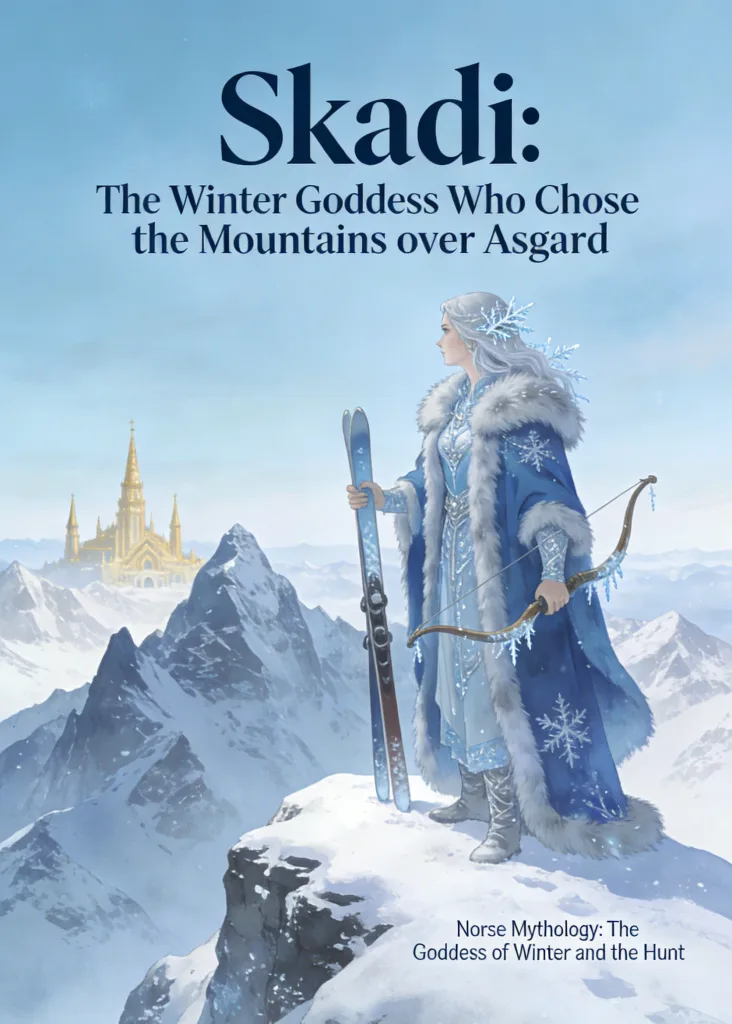
Throughout my repeated readings of Norse mythology, Skadi remains the character who most resonates with me. She is neither a docile deity nor a tamed symbol—she is the daughter of Jötunheim, the untamed spirit dwelling above the snowline and within the howling winds. Her story is, at its core, a choice between belonging and freedom.
Blood Debt and Negotiation: She Entered the Realm of the Gods with Bow and Arrow
Her father, Thjazi, was slain by the Aesir for kidnapping the goddess of youth, Idun. Most would have silently swallowed their grief. But not Skadi. She donned her armor and entered Asgard alone, not to beg, but to demand “blood money”—an ancient form of compensation.
What courage did this require? Facing the entire pantheon, she did not flinch. And the gods, unusually, chose compromise, offering two conditions: first, Loki must make her laugh; second, she could choose a husband among the gods—but only by looking at his feet.
Those “Perfect” Feet Proved a Misunderstanding
I spent an entire afternoon pondering this detail. Feet, often overlooked in mythology, became the switch of fate here. Skadi naturally assumed the cleanest, most symmetrical feet belonged to Balder, the god of light—after all, he was the embodiment of beauty.
Yet she chose Njórd, god of the sea. His feet were indeed clean, but only because he walked upon waves daily—not by nature’s grace. In that moment, I seemed to hear fate’s quiet chuckle: she sought tranquil, warm light, but welcomed the salty, clamorous roar of the tide.
After Nine Nights: The Complete Rupture of Two Ecosystems
Their marriage lasted only eighteen nights—nine each in the other’s domain. The outcome was inevitable:
- Njórd could not endure the mountains. He shivered in the wind and snow, longing for the cries of seabirds and the rhythm of waves. He once said, “The howl of wolves is piercing, the cold wind like a blade—there is no moment of peace here.”
- Skadi loathed the sea. She couldn’t stand the clamor of seabirds, the muddy tidal flats, nor the relentless dampness and clamor. She belonged to the silence of snow-covered peaks, to the moment a bowstring vibrates, to the crisp sound of skis gliding across frozen earth.
This wasn’t a clash of personalities, but a conflict of fundamental existence. They came to understand: their worlds held no place for each other.
She turned and left, returning to her true homeland
In the end, Skadi neither stayed in Asgard nor sought another partner. She returned to Jotunheim—the realm of the giants, called “the Land of Noise” by the gods. Yet to her, it was not chaos but order; not savagery but home.
She donned her snowshoes once more, shouldered her bow and arrows, and became the solitary inhabitant of the mountain peaks. People later called her the “Ski Goddess” or “Skadi the Huntress,” but these titles were not bestowed by the gods—they were identities she earned through a lifetime of living.
Her Choice: A Modern Revelation
Rereading Skadi’s story today, I increasingly see her as a mirror. We’re often urged to integrate into systems or accept arrangements that fail to nourish our souls. She did the exact opposite: trading stability for freedom, recognition for authenticity.
She wasn’t a rebel, but a clear-eyed soul. She knew where she belonged—not in palaces or on altars, but on the wind-swept ridges where snow and wind howled.
So as I write these words, what I most wish to convey is not mythological scholarship, but an attitude: True strength sometimes lies not in conquering the world, but in having the courage to leave what doesn’t suit you and return to your own quiet place.
Skadi never became part of Asgard, yet in doing so, she became eternal.
Recommended reading: Juniper Tree: Spiritual Meaning and Ancient Wisdom