


You may have heard of the sun god Ra or the lord of the underworld Osiris, but have you ever noticed the man lying on the ground—Geb? He is one of the most underrated figures in ancient Egyptian mythology. Today, we’ll talk about this “triple-threat” deity who is both the earth, the sky, and the ruler of wealth and the dead.
Earth and Sky: Who Exactly Is Who?
In most people’s minds, Nut is the sky goddess, arching like a giant bow over the earth she covers. Her husband Geb is the very ground she spans. This image is classic and straightforward.
Yet intriguingly, fragments of ancient texts suggest Geb’s role is more complex. He isn’t merely the “lying flat” ground; at times, he’s associated with the sky, air, and even the space above the earth. This can be perplexing: how can the god of the earth be connected to the heavens?
In truth, this precisely reflects the ancient Egyptians’ dynamic and complex understanding of the world. Geb’s core identity is unquestionably that of the god of the earth. He governs earthquakes (said to be his laughter), vegetation, minerals, and is the foundation of all life and wealth. His union with Nut represents the most fundamental division of the world: sky above, earth below.
How Did the Universe Come to Be? It All Starts with These Three “Big Shots.”
To grasp Geb’s significance, we must first examine how the entire cosmos was created. Ancient Egyptians had a renowned “Ennead” of nine deities, and the story begins with a creator god named Atum-Ra.
Atum emerged from the primordial waters (Nun) through self-generation, embodying “the Perfect One.” Later, he merged with the sun god Ra to become Atum-Ra, symbolizing light, life, and cosmic order. He created the first divine pair: Shu, the god of air, and Tefnut, the goddess of moisture.
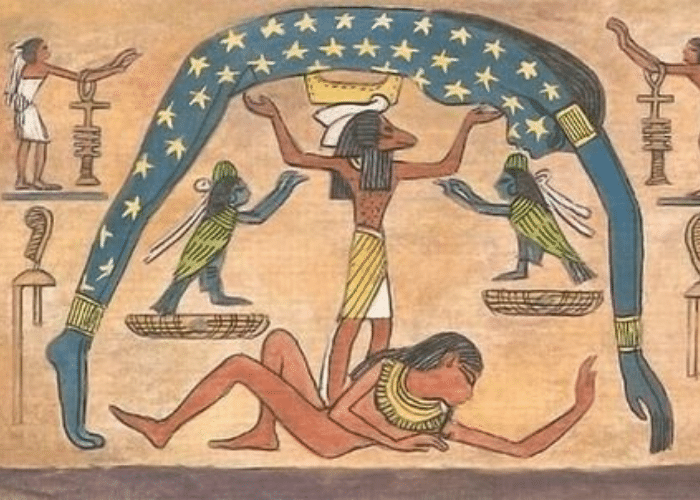
Shu and Tefnut then gave birth to Geb and Nut. Thus, Geb and Nut are the second generation of gods, serving as the parents of the four core deities: Osiris, Isis, Seth, and Nephthys. It can be said that without Geb and Nut, the subsequent compelling narratives concerning death, resurrection, and kingship would not exist.
The pivotal moment arrives: Father Shu (Air) forcibly separates Geb (Earth) and Nut (Sky). It is precisely this action that creates the space between heaven and earth, enabling life to emerge. Thus, Geb is not merely a passive ground; he himself is an integral part of the act of creation.
Geb’s “Triple Identity”: Far More Than Nut’s Husband.
Many perceive Geb as merely Nut’s supporting character, a backdrop. Yet closer examination reveals his immense power, manifested in at least three aspects:
1. Source of Wealth.
Geb is the master of all subterranean treasures. Whether gold mines, precious stones, or crops growing from the earth, they all fall under his domain. Ancient Egyptians offered sacrifices to him, praying for bountiful harvests and wealth. You can think of him as a super-landlord—and a generous one at that.
2. Bestower of Royal Authority.
Pharaohs bore the formidable title “Heir of Geb.” This signified that their power did not arise spontaneously but was directly inherited from the god of the earth. This greatly elevated the sacredness and legitimacy of the pharaoh’s rule. Here, Geb played the role of the “bestower of divine mandate.”
3. Guardian of the Afterlife.
Since the earth “devours” the deceased, Geb also held jurisdiction over the dead. In some funerary texts, he was depicted as both judge and protector of the departed. He not only provided burial grounds but also determined the fate of the deceased in the afterlife. This transformed him from a simple nature deity into a god deeply involved in the pivotal events of human existence—birth and death.
What’s the most fascinating detail? Legend holds that Geb’s laughter causes earthquakes! Imagine: a deity lying on the ground, laughing, and the entire world trembles. This image is both powerful and vibrant, completely shattering the stereotype that “earth equals silence.”
Why is Geb so important?
In summary, Geb’s significance lies in providing the physical foundation and spiritual framework for the entire Egyptian cosmos.
- Physically, he is the stage upon which the world exists. Without him, Ra’s solar boat would have nowhere to sail, and Osiris’s resurrection would have no place to occur.
- Spiritually, he represents cyclical rebirth. The sun is reborn daily from Nut’s body, while grain sprouts from Geb’s form. This cyclical concept lies at the heart of ancient Egyptian belief.
- In terms of order, he joins Nut and Ra in upholding cosmic order (Ma’at) against chaos (Isfet). Worshiping them ensures the world’s enduring stability.
So the next time you see that classic mural depicting the Sky Goddess arching over the Earth God, remember: the man lying beneath is no supporting character. He is the cornerstone of creation, the wellspring of wealth, the grantor of kingship, and the pivotal link between life and death. He is Geb—the silent, mighty god who anchors the entire Egyptian cosmos.
References & Further Reading
- Study.com – Egyptian God Geb: Mythology & Significance
https://study.com/academy/lesson/egyptian-god-geb-mythology-significance.html - Wikipedia – The Ennead (Egyptian Mythology)
https://en.wikipedia.org/wiki/Ennead - StudyGuides.com – Ancient Egyptian Deities Overview
https://studyguides.com/study-methods/study-guide/cmk5bw1k01i3d01d5m4azwhn8
Comment on “Geb | Earth God, Sky God, and Creator God Explained”