I’ve always been fascinated by myths, especially those about love and human relationships. So when I began researching “China’s goddess of love,” I assumed it would be similar to the Western tradition—like Venus or Aphrodite—with a single, clearly defined goddess presiding over love. The result? It turned out to be nothing like that.
The more I researched, the more I discovered that Chinese deities associated with “love” aren’t fixed figures with a single, unified name. Different regions, eras, and purposes have their own distinct interpretations. This actually makes perfect sense—given China’s vast size and long history, how could one name possibly encompass the entirety of ‘love’?
1. The Old Man Under the Moon: Not a goddess, but the one who decides “who ends up with whom”
First, let’s be clear: in traditional Chinese belief, the figure most directly responsible for “matchmaking” is actually an old man—called Yue Xia Lao Ren (Moon Old Man) or Yue Lao (Moon Old Man).
He isn’t a goddess, but his job is to arrange people’s marital bonds. Legend has it he holds an invisible red thread (called the “red thread of fate”) that ties the ankles of two people destined to marry. No matter how far apart they are or how different their backgrounds, once the red thread connects them, they will eventually come together.
This idea reflects a distinctly Chinese concept: love isn’t something you chase through effort, but something predestined by fate. This notion of “destiny” (yuánfèn) holds particular importance in the hearts of many older generations.
So if you ask, “Who decides who I fall in love with?” many will smile and say, “Go ask the Matchmaker God!”
2. The Weaver Girl: China’s Most Famous “Female Lead in Love Stories”
If the Matchmaker God is the “arranger,” then the Weaver Girl is the “heroine of love stories.”
She comes from China’s most famous love legend—The Cowherd and the Weaver Girl. In the tale, she is a celestial maiden who weaves clouds, while Cowherd is an earthly cowherd. Though deeply in love, they are forcibly separated by the Queen Mother of the West, permitted to meet only once a year on the seventh day of the seventh lunar month across the Magpie Bridge.
This story has endured for millennia because it embodies the belief that true love can overcome any obstacle—even a year apart is worth the wait.
Every Qixi Festival (now often called “Chinese Valentine’s Day”), people remember the Weaver Girl. She represents not “arranged marriages,” but love pursued willingly, a devotion willing to sacrifice for love.
Thus, the Weaver Girl symbolizes “faithful love” more than a goddess who governs romance.
3. The Queen Mother of the West: The Lofty “Rule-Maker”
Speaking of the Queen Mother, also known as the Queen Mother of the West, she is no ordinary figure. She is the supreme ruler of the celestial realm, overseeing the elixir of immortality, Mount Kunlun, and the order of the heavenly court.
In the Cowherd and Weaver Girl tale, it was she who ordered the Weaver Girl’s return to heaven, forbidding her from being with a mortal. While she may seem “heartless,” her actions stem from upholding celestial laws.
Thus, the Queen Mother’s role in love isn’t to ‘facilitate’ but to “impose boundaries.” She embodies the principle that love must not defy the cosmic order established between heaven and earth.
Think of her as the “celestial guardian”—not necessarily opposed to love, but determined to ensure it doesn’t disrupt the greater cosmic harmony.
4. Flower Goddesses: Embodiments of Spring, Beauty, and Romance
Beyond these figures, folklore features a lesser-known yet fascinating group—Flower Goddesses.
Some traditions hold that each month of the year has its own flower fairy, responsible for ensuring that particular bloom blooms on schedule. For instance, March brings peach blossoms, April peonies… Flowers have long been associated with youth, beauty, and romance.
Though Flower Gods don’t directly oversee “who marries whom,” people admire blossoms in spring while seeking romantic connections, believing flourishing flowers foretell smooth relationships. Thus, Flower Gods function more as masters of romantic ambiance—they imbue the world with romance, making hearts more easily stirred.
5. Magu: The “Auspicious Symbol” Blessing Marriages
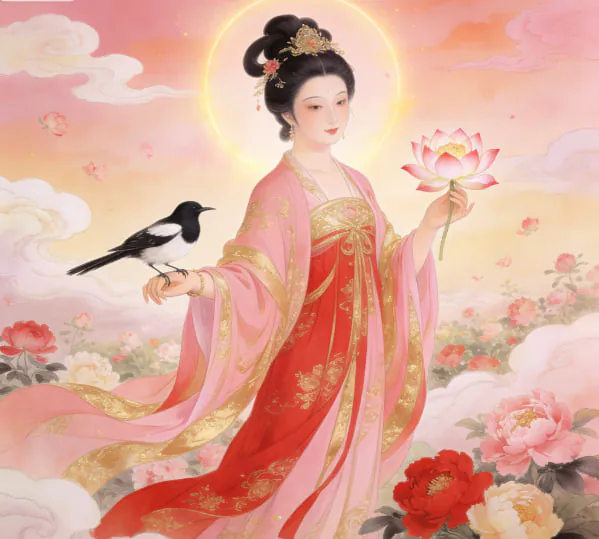
Finally, let’s discuss Magu. She is a female immortal frequently depicted in longevity paintings, holding a divine peach symbolizing longevity.
Yet she is also commonly featured in wedding ceremonies. Why? Because her youthful beauty and eternal youth represent “everlasting youth” and “lasting happiness.” People paint her image not to match couples, but to wish newlyweds health, affection, and a lifetime together like hers.
Thus, Magu’s connection to love is more about “bestowing blessings” than “dictating outcomes.”
Love in China Has Never Been a Solo Endeavor
After researching this, my strongest realization is: Chinese culture lacks an all-powerful goddess of love.
Because the Chinese perspective on love has never been one-dimensional.
- Who ends up with whom? — That’s up to Yue Lao (fate).
- How deep is the love? — Weigh in with Weaver Girl (loyalty and sacrifice).
- Can they be together? — Queen Mother of the West decides (rules).
- Is the atmosphere harmonious? — Flower Goddess lends a hand (nature and beauty).
- Will they be happy after marriage? — Magu bestows blessings (longevity and auspiciousness).
You see, love is broken down into many parts, each with its own “manager.” This actually reflects the Chinese people’s pragmatic attitude toward relationships: Love isn’t just about heart-pounding excitement; it also involves family, society, time, and even the cosmic order.
So, next time someone asks, “Who is the goddess of love in China?” you can smile and reply:
“We don’t have just one, but an entire ‘love team’!”
Recommended reading: Geb | Earth God, Sky God, and Creator God Explained