


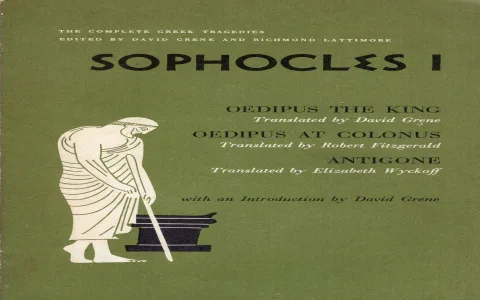
I. He Was More Than a Poet—He Was a Participant in His Era
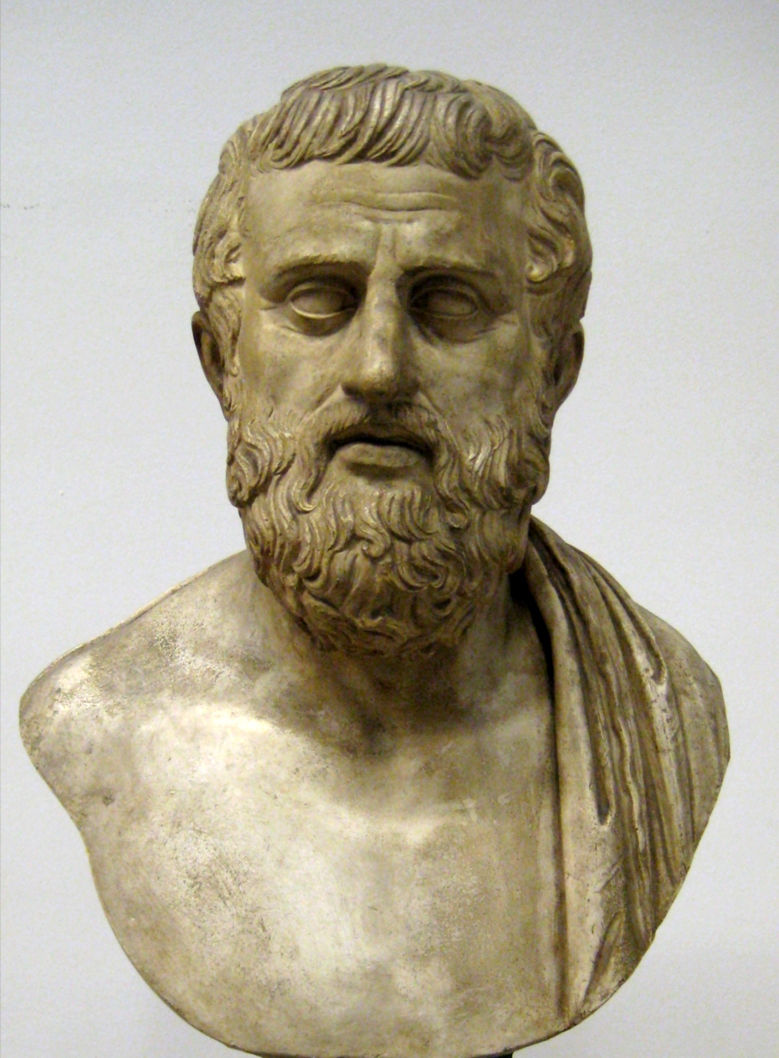
Sophocles (c. 496–406 BC) is often grouped with Aeschylus and Euripides as one of the three great tragic poets of ancient Greece. But what truly astonishes me is that he was far more than just a “playwright”—he was handsome, erudite, and even served as a general and financial official. Imagine if Shakespeare had also been a decorated general—wouldn’t that strike you as incredible?
He lived nearly ninety years, witnessing Athens’ descent from its golden age before the Peloponnesian War into gradual decline. This experience of standing at the pinnacle while witnessing the collapse left an indelible mark on his work. It’s said he won his first dramatic competition against the then-dominant Aeschylus—akin to a new director winning Best Picture at the Oscars with their debut film. I gradually realized his success was no accident: he was not only at the heart of Athenian culture but directly involved in political decision-making.
He fought alongside Pericles and managed the state treasury. He didn’t observe power from afar—he wielded the scepter himself. As I often ponder: If today’s most successful Oscar-winning director were also a retired general and high-ranking official—that would be Sophocles. He didn’t write fictional power games; he wrote his own journey.
II. Privileged Origins: The “Invisible Wings” Beyond Talent
Sophocles’ brilliance was undeniable, yet without his family’s foundation, such achievements would have been unlikely.
His father, Sophiles, was reportedly a wealthy manufacturer, possibly specializing in armor or military equipment. This foundation freed him from financial struggles, allowing him to pursue the finest education available. More crucially, as a native-born Athenian free citizen, he enjoyed full political rights and access to educational resources—privileges utterly unattainable for slaves or foreigners (Metics).
The “holistic education” (Paideia) he received epitomized Athens’ elite training system:
- Literature and Rhetoric: From childhood, he studied Homer and Hesiod, mastering grammar, oratory, and music—skills that empowered him in politics and laid the foundation for his dramatic works;
- Musical Talent: He excelled at playing the lyre, even performing publicly. Given the crucial role of chorus in ancient Greek tragedy, his musical training became a natural advantage in composition;
- Physical Training: Embracing the ideal of “kalokagathia” (beauty and goodness united), he excelled in athletics and gymnastics during his youth—not merely an aesthetic pursuit, but also a civic duty.
III. Early Fame: Stepping onto the Historical Stage at 16
His talent was recognized early. In 480 BC, following Greece’s decisive victory over Persia at the Battle of Salamis, the 16-year-old Sophocles was chosen as the lead singer for the celebratory chorus—a role requiring him to perform naked and anointed with oil, per the custom of the time. This honor acknowledged both his handsome physique and his exceptional musical prowess.
This experience made me realize: his plays captured the Athenian spirit so precisely because he had grown up immersed in it. He understood mythology, civic values, and how chorus and plot intertwined—all laying the groundwork for his later innovations.
IV. How Did He Reinvent Tragedy?
Sophocles wasn’t merely a traditionalist—he was a revolutionary:
- Introduced a third actor: Aeschylus typically used only two. Adding a third immediately complexified dialogue, created tension in relationships, and made plots more intricate;
- Diminished the chorus’s dominance: The chorus no longer drove the plot but became an observer—a mirror reflecting the protagonists’ inner struggles;
- Focused on individual psychology: His characters were no longer puppets of fate, but flesh-and-blood mortals capable of hesitation and error. They battled destiny and their own flaws.
V. Echoes 2,500 Years Later: Why Do We Still Read Him?
What strikes me most is the “modernity” of Sophocles’ work.
The inescapable sense of fate and the dissonance of self-knowledge in Oedipus Rex directly inspired Freud’s concept of the “Oedipus complex”—this is not merely literature, but one of the origins of psychology.
And Antigone? Whenever I see someone standing up against an unjust system with their small frame, I think of her. Whether it’s real-life civil disobedience or the lone hero resisting tyranny in sci-fi films, the essence of Antigone lingers within. Choosing to do what is right, knowing it will lead to destruction—this nobility was already masterfully captured by Sophocles over two thousand five hundred years ago.
The questions he posed remain relevant today:
- When suffering is inevitable, how should one bear it?
- Who ultimately defines justice?
- Amidst the torrent of fate, how much autonomy can we truly preserve?
Only after studying him did I truly grasp: Sophocles never wrote about ancient Greek gods, but about eternal humanity—human arrogance, blind spots, and the courage to grope for moral bearings in darkness. Precisely because he focused his lens on the “individual,” his stories transcend time and space, resonating directly with our present.
Now, whenever I watch any play, film, or even read a novel, I unconsciously seek that “Sophoclean” core—not how thrilling the plot is, but whether the characters, caught between fate and choice, embody authentic humanity. This, perhaps, is the most precious legacy he has left us.