


Skip to content
Mythology Story | Unveiling Ancient Legends & Modern Meanings

Mythology Story | Unveiling Ancient Legends & Modern Meanings

  • Home
  • Mythical Figures
  • World Mythology
    • Greek & Roman
    • Norse
    • Egyptian
    • Eastern
  • Myth & Modern Life
  • Symbolism & Meanings
  • Toggle search form
  • Geb | Earth God, Sky God, and Creator God Explained
    Geb | Earth God, Sky God, and Creator God Explained Egyptian
  • Sophocles: The Life, Works, and Modern Echoes of the Tragic Master
    Sophocles: The Life, Works, and Modern Echoes of the Tragic Master Mythical Figures: Gods, Heroes & Legendary Creatures
  • Skadi: The Winter Goddess Who Chose the Mountains over Asgard
    Skadi: The Winter Goddess Who Chose the Mountains over Asgard Norse
  • Meeting Cerridwen: Finding True Transformation through Shadow Work and the Cauldron of Inspiration
    Meeting Cerridwen: Finding True Transformation through Shadow Work and the Cauldron of Inspiration Mythical Figures: Gods, Heroes & Legendary Creatures
  • The Legend of the Phoenix – From Greek Mythology.
    The Legend of the Phoenix – From Greek Mythology. Greek & Roman
  • Apollo The Greek God of Light, Music, Prophecy, and More
    Apollo: The Greek God of Light, Music, Prophecy, and More Greek & Roman
  • Mawu: West Africa's Supreme Goddess of Creation, Compassion, and Cosmic Balance
    Mawu: West Africa’s Supreme Goddess of Creation, Compassion, and Cosmic Balance World Mythology: Legends from Every Corner of the Earth
  • Chinese Goddess of Love Names: Discover the Different Titles She Holds
    Chinese Goddess of Love Names: Discover the Different Titles She Holds Eastern

Knowing God – Pan: Why Is He Often Depicted Holding a Flute?

Posted on 02/02/202602/02/2026 By Julian Sterling No Comments on Knowing God – Pan: Why Is He Often Depicted Holding a Flute?
Knowing God – Pan: Why Is He Often Depicted Holding a Flute?

Table of Contents

Toggle
  • Where did Pan come from?
  • What’s the story behind that flute?
  • What Happened to Pan Later?
  • So what does that flute truly signify?

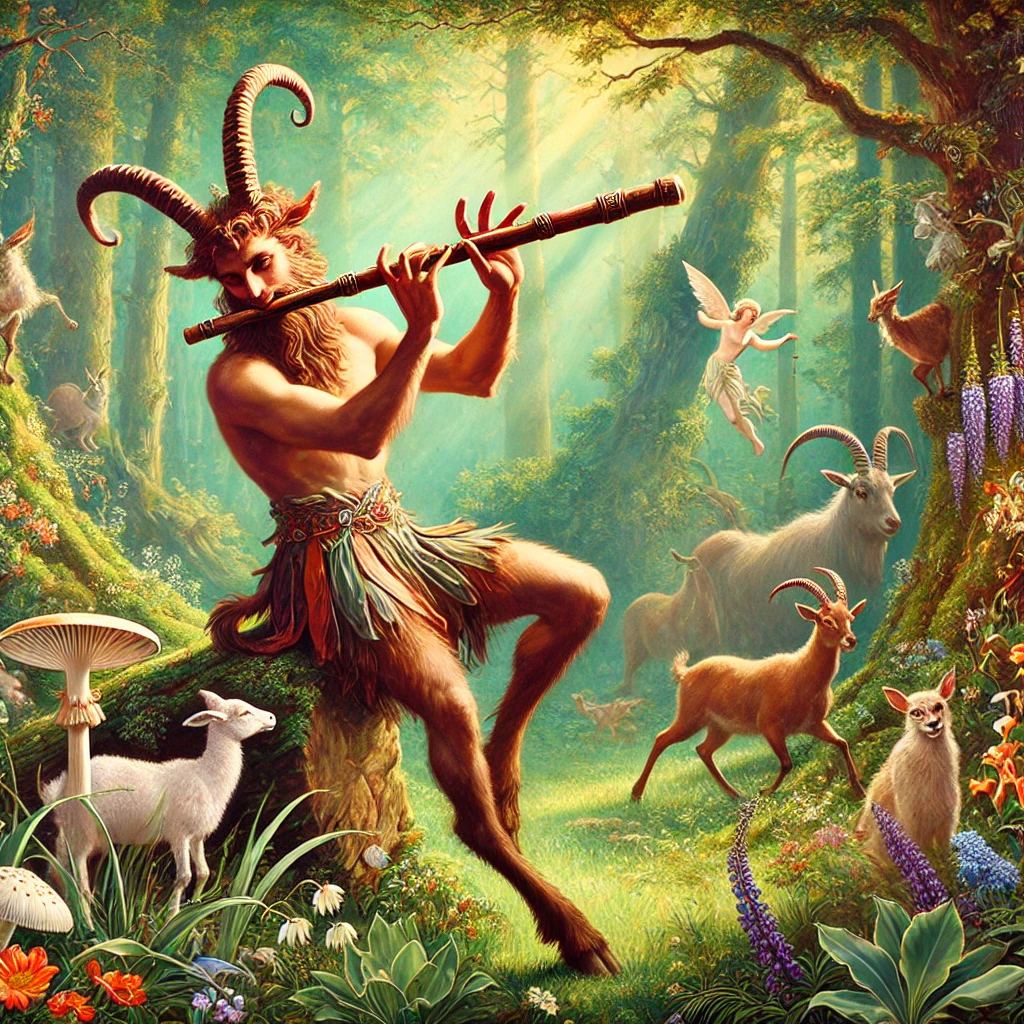
Have you ever seen a half-man, half-goat god in books or paintings? Pan has a beard, horns on his head, and always holds a set of pipes of varying lengths. Yes, that’s the fellow called “Pan.” I used to see Pan all the time and wonder: Is this flute really that important?

Later I learned it’s no ordinary accessory.

Where did Pan come from?

Pan’s homeland was in a place called Arcadia in Greece. It was full of mountains, very remote, and sparsely populated. So Pan was born bound to nature, unlike those polished city gods.

Some say Pan was the son of the famous messenger god Hermes. That explains why Pan also rules over borders and travel—after all, the wilderness itself is the frontier of the civilized world.

Pan’s very form embodies this duality. Half-man, half-goat, he stands as the dividing line between civilization and savagery. Call him human, yet he has goat legs; call him beast, yet he thinks and speaks. This contradiction is the essence of Pan’s allure.

What’s the story behind that flute?

This is the most intriguing part. Pan is most famous for the flute he holds, called the “Syrinx.” The name sounds beautiful, but the story behind it is rather heartbreaking.

Legend has it that Pan fell in love with a nymph named Syrinx. But the girl wanted nothing to do with him. Whenever she saw Pan chasing after her, she’d panic and run away. As he was about to catch her, Syrinx cried out to the river god for help. Without hesitation, the river god transformed her into a clump of reeds by the riverbank.

Pan rushed to the riverbank, only to embrace a pile of reeds. Heartbroken, he cried out to the reeds. When the wind blew, the reeds whistled in response. Inspired, Pan cut several reeds of varying lengths, bound them together, and fashioned the world’s first pan flute. From then on, he played this flute—both to commemorate his lost love and to console himself.
Knowing God – Pan: Why Is He Often Depicted Holding a Flute?

So you see, this flute is more than just an instrument. It embodies a failed love story, a regret forever beyond reach. Simple and primal, its sound shifts from joyful to sorrowful, much like the wilderness itself—both beautiful and perilous.

I deliberately sought out authentic pan flute music, not the effects-laden versions from movies. The sound truly carries a wild quality. Sometimes piercingly shrill, other times low and unsettling. This perfectly mirrors Pan’s other side—he can bring panic! Imagine walking alone in a deep, ancient forest and suddenly hearing strange flute music. Wouldn’t it terrify you? That sudden, inexplicable dread is Pan’s masterpiece.

What Happened to Pan Later?

As times changed, Pan’s image evolved. Among the Romans, he gained a new name: “Faunus,” meaning much the same—still the god of forests and fields.

Even more fascinating is that because “Pan” means “all” in Greek, some philosophers saw him as a symbol of the entire universe, representing the unity of all things.

Yet the most poignant tale surrounds Pan’s “death.” The historian Plutarch recorded an account: During the reign of Emperor Tiberius, sailors at sea heard a mysterious voice proclaim, “The great god Pan is dead!” This story is often seen as marking the end of the old pantheon’s era and the dawn of a new age—such as the Christian era.

But did Pan truly die? Of course not. His image endured, even influencing later eras. Consider the devils depicted in medieval paintings—with goat horns and hooves—didn’t they “borrow” their appearance from Pan?

Ah, it’s truly poignant. A god embodying pure nature and primal emotion ultimately became a symbol of evil.

So what does that flute truly signify?

Ultimately, Pan’s flute embodies the essence of his identity. Born from a failed pursuit, crafted from reeds plucked from nature, its melody can soothe shepherds’ hearts one moment and terrify souls in the dead of night the next.

It isn’t a simple prop, but a complete story. It reminds us that the world isn’t always gentle and charming—it also has a wild, uncontrollable, even terrifying side. And Pan is the embodiment of all that.

Studying these small details in mythology is truly fascinating. It makes you realize that ancient people didn’t create these gods merely to tell stories, but to understand the complex and mysterious world in which Pan and his kind existed.
Greek & Roman Tags:Knowing God – Pan

Post navigation

Previous Post: Izanagi: A God’s Sorrow and Creation.

Related Posts

  • Odysseus as the Master of Two Worlds
    The Odyssey Meaning: Odysseus as the Master of Two Worlds Greek & Roman
  • Sophocles Meaning: The Father of Tragedy and His Mythological Legacy
    Sophocles Meaning: The Father of Tragedy and His Mythological Legacy Mythical Figures: Gods, Heroes & Legendary Creatures
  • The Legend of the Phoenix – From Greek Mythology.
    The Legend of the Phoenix – From Greek Mythology. Greek & Roman
  • Apollo The Greek God of Light, Music, Prophecy, and More
    Apollo: The Greek God of Light, Music, Prophecy, and More Greek & Roman

Leave a Reply Cancel reply

Your email address will not be published. Required fields are marked *

Archives

  • February 2026
  • January 2026

Categories

  • Eastern
  • Egyptian
  • Greek & Roman
  • Myth & Modern Life: Names, Pop Culture & Branding
  • Mythical Figures: Gods, Heroes & Legendary Creatures
  • Norse
  • Symbolism & Meanings: Decoding the Language of Myths
  • World Mythology: Legends from Every Corner of the Earth

Recent Posts

  • Knowing God – Pan: Why Is He Often Depicted Holding a Flute?
  • Izanagi: A God’s Sorrow and Creation.
  • The Legend of the Phoenix – From Greek Mythology.
  • The Odyssey Meaning: Odysseus as the Master of Two Worlds
  • Apollo: The Greek God of Light, Music, Prophecy, and More
  • Skadi: The Winter Goddess Who Chose the Mountains over Asgard
    Skadi: The Winter Goddess Who Chose the Mountains over Asgard Norse
  • Izanagi: A God’s Sorrow and Creation.
    Izanagi: A God’s Sorrow and Creation. Eastern
  • Sophocles: The Life, Works, and Modern Echoes of the Tragic Master
    Sophocles: The Life, Works, and Modern Echoes of the Tragic Master Mythical Figures: Gods, Heroes & Legendary Creatures
  • Sun Wukong: The Mythology, Origins, and Legend of the Monkey King
    Sun Wukong: The Mythology, Origins, and Legend of the Monkey King Eastern
  • Odin's Ravens: The Secrets of Huginn and Muninn
    Odin’s Ravens: The Secrets of Huginn and Muninn Mythical Figures: Gods, Heroes & Legendary Creatures
  • Meeting Cerridwen: Finding True Transformation through Shadow Work and the Cauldron of Inspiration
    Meeting Cerridwen: Finding True Transformation through Shadow Work and the Cauldron of Inspiration Mythical Figures: Gods, Heroes & Legendary Creatures
  • The Most Revered Deities in Hinduism: Vishnu, Shiva, Devi, and the Unity of the Divine
    The Most Revered Deities in Hinduism: Vishnu, Shiva, Devi, and the Unity of the Divine World Mythology: Legends from Every Corner of the Earth
  • Chinese Goddess of Love Names: Discover the Different Titles She Holds
    Chinese Goddess of Love Names: Discover the Different Titles She Holds Eastern

Powered by Mythology Story , About Us


sitemap