



Have you ever wondered how the land beneath our feet came to be? Long, long ago, the people of Japan believed two deities—Izanagi and Izanami—created their homeland.
I first heard their story in an anime. But when I actually read the original myth, I discovered it was no lighthearted fairy tale. This is a story of love, mistakes, death, and immense sorrow. Goodness, the imagination of ancient storytellers—both romantic and brutal!
A World Begun with a Spear.
In the beginning, the world was a chaotic mass, like a pot of boiling porridge. The ancient gods dwelling in the heavens decided this wouldn’t do—they needed something tangible. So they entrusted the task to two young deities of the seventh generation: the elder brother Izanagi and the younger sister Izanami.
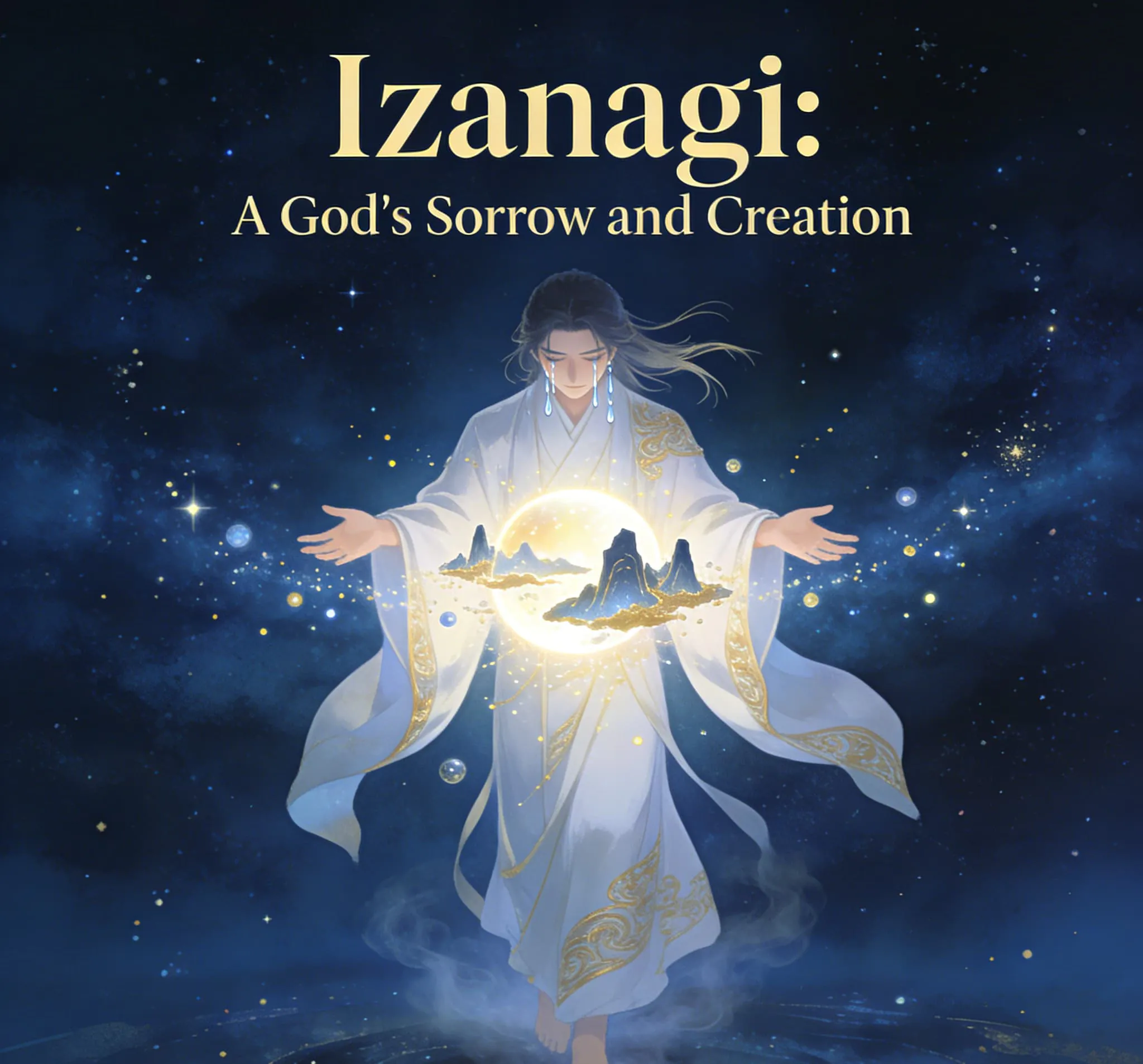
Standing upon the “Heavenly Floating Bridge” connecting heaven and earth, they held a sacred spear called the “Heavenly Jeweled Spear.” This spear was extraordinary, studded with jewels. They plunged it into the sea below and stirred, stirred, stirred. When they lifted the spear, the saltwater dripping from its tip solidified into an island! This island was named “Onogori Island,” meaning “the island that formed itself.”

With the island formed, they descended from the heavens. To marry, they erected a great pillar on the island. Then, they agreed to walk around the pillar, starting from opposite sides. Whoever spoke first would become the husband. Izanami spoke first: “Ah, what a fine man!” Izanagi responded. Thus, they became husband and wife.
But then came the problem. According to the rules, the man should have spoken first. This reversal of order had serious consequences.
The Price of Error and a Fresh Start.
Their first child was a boy named Ebisu. He was physically impaired, unable even to stand upright. In those times, this was seen as an ill omen. With no other choice, they placed the child in a small boat and set him adrift on the waves. Can you imagine the heartache?
Izanagi and Izanami were both confused and deeply saddened. They returned to the heavens to consult the elder gods. Upon hearing the story, the gods declared: “Oh, so that’s it! You reversed the proper order—how could a woman speak first?”
So they returned to the island and performed the ritual anew. This time, Izanagi spoke first: “Ah, what a splendid woman!” Then Izanami responded. This time it was right! From then on, they smoothly gave birth to Japan’s eight main islands, along with mountains, rivers, trees… all manner of nature deities (the Japanese call them “kami”).
You see, ancient people imagined the world’s creation as a sacred marriage. But this union carried the seeds of tragedy from the very beginning.
Farewell on the Road to the Underworld.
Everything was perfect until they gave birth to the Fire God, Kagutsuchi. Born blazing hot, he instantly incinerated Izanami.
Izanagi’s world shattered instantly. Unable to accept his wife’s departure, he was overcome with grief. In his rage, he drew his sword and slew his newborn son, the Fire God. The Fire God’s blood splattered onto the rocks, transforming into new deities. But this offered him no solace.
He made a desperate decision: he would journey to Yomi, the realm of the dead, to bring his wife back!
He found Izanami. She told him she had eaten the food of Yomi and could not simply return. But she agreed to ask the gods of Yomi, on the condition that Izanagi never look back at her. Izanagi promised.
But the wait dragged on. His anxiety and dread grew unbearable. Finally, he snapped off one end of his comb and lit it. As the flame flared, what did he see? No longer his beautiful wife, but a horrifying, rotting corpse crawling with maggots.
Izanami was enraged by his betrayal. She felt her dignity utterly trampled. She sent the hideous women of the Underworld to pursue Izanagi. He fled desperately, hurling items from his body to block his pursuers—his black hair transformed into grapes, his comb became bamboo shoots… Finally, he reached the exit of the Underworld.

He rolled a massive boulder to seal the entrance. Through the stone, the couple shared their final words.
Izanami declared, “Since you have shamed me thus, I shall slay a thousand people in your land each day!”
Izanagi replied, “Then I shall build fifteen hundred birthing chambers daily, bringing new life into the world!”
With that, they parted ways forever. Life and death were henceforth separated by this colossal boulder, with no path for return.
The ending of this tale leaves a heavy weight on the heart. It teaches us that some mistakes, once made, can never be undone. Izanagi’s love was genuine, yet his fear and distrust ultimately destroyed everything he sought to save. This is no mere myth—it is the truest reflection of human nature!
Recommended reading: